You only get one shot at setting yourself up for retirement. Suppose you get it wrong; it's not as easy as going back to work and finding another role. It might be your health, or you’re just done with that stage of your life. Once the income tap is turned off, it's crucial that you can turn on the passive income tap and that it provides you with a meaningful income to live the retirement you want.
So whether you’re retiring in one year, five years or twenty years, here are five golden rules to make sure you make the most of your retirement savings, so you can actually go and live an amazing lifestyle in retirement.
Why should you read this article?
Without listing my credentials in painful detail, you need to know if I am credible to give you tips on this subject because there are so many ‘experts’ out there who have an opinion.
In a nutshell, I’ve been a Financial Adviser for nearly 15 years, have helped hundreds of Kiwis plan for retirement, have managed teams of Financial Advisers across the country and have one of the largest finance podcasts in the country, Cheques & Balances, which has 75,000 downloads a month.
Rule 1: Retirement does not mean you can't take risks
I hear this all the time: “I’m 65 now, which means I can’t take risks anymore; I should just stick the money in a term deposit and be conservative.”
I find that a lot of people define risk in terms of “how likely am I to lose all of my money?”
This is the wrong way to think about risk and is a huge mistake.
Yes, you can invest all your money in your mate’s company or all your retirement savings in a property developer’s fund. That is risk; you could lose all your money in that situation.
However, let’s assume you are investing in a diversified manner – across multiple asset classes, countries, industries, etc. When you invest in this manner, the term risk does not mean Will I lose all my money. It means what degree of ups and downs and negative return periods you’re comfortable with, in exchange for a higher return over the long term.
Some people think if they lose money, it just won’t come back. That’s not the case. A term deposit is actually the only investment that’s guaranteed to go backwards over time. A diversified portfolio, a managed fund, or your KiwiSaver will bounce up and down, but it will grow your money significantly more over the long term.
Why this matters: yes, you need to be able to sleep at night. But at the end of the day, if you’re not comfortable with some volatility, it means you’re simply not going to be able to enjoy retirement as much as you could. That comes down directly to your retirement savings. If you’ve already got a lot saved, you don’t need to take much risk at all. But for the average Kiwi, you do.
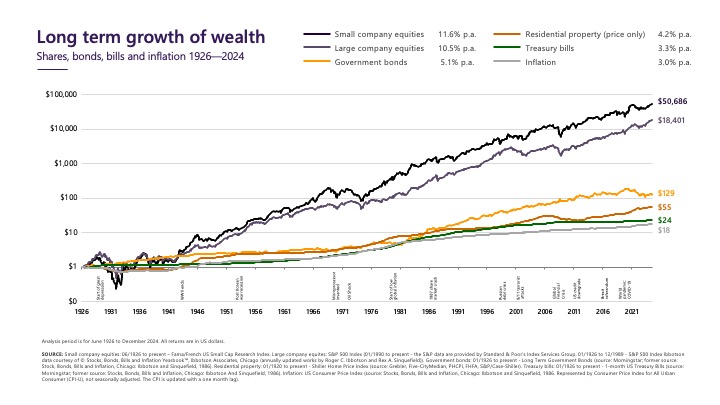
I am not recommending that if you are five years from retirement, you should have all your money in an aggressive, high-growth fund. A combination of defensive and growth assets means you will not erode your capital as quickly in retirement, and can enjoy a better quality of life. If you don’t invest for some growth over a long enough period, and you’re only keeping pace with inflation, you’re simply not going to get to enjoy yourself as much once you get there.
To show how material this decision actually is:
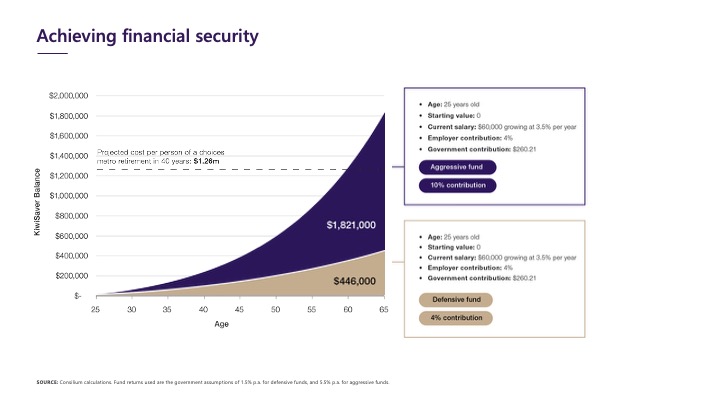
If you’re heading into retirement, you’re not going to sit in an aggressive fund, but you might sit in a balanced fund. The difference between a balanced fund and a defensive fund is still very material, as long as you’re comfortable with the volatility that comes with it.
Of course, this graph doesn’t show you the volatility you will experience at points in time. Investing at the time never feels like a smooth journey. There will be periods where you will question whether markets will recover. However, as you can see from the graph above, the implications over the long term are very material – same income, same timeframe to invest, same contributions, same lifestyle, same income. With one decision and a level of financial education, the outcome can be 4X.
Rule 2: Don't try to time the market
People get scared when it comes to investing in the market, and it’s easy to see why. The graph below isn’t your heart rate thinking about having enough for retirement. It is showing the performance of the S&P 500 each quarter over 80 years.
You will notice there is no trend. It’s not like a down quarter results in an up quarter or vice versa. It is random. If there were a clear trend, there would be no risk in investing.
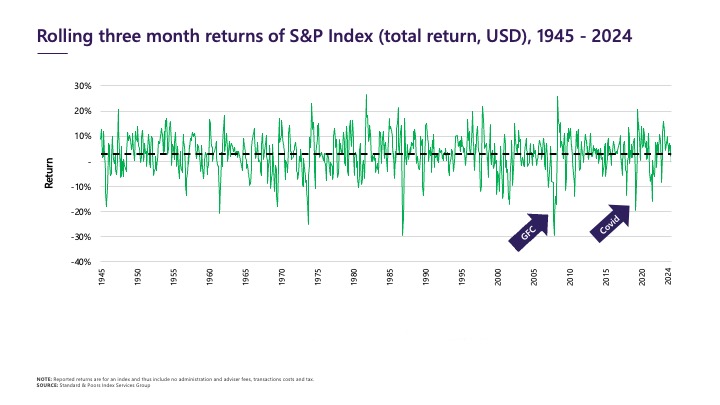
When people ask “should I invest now, in a week, in a month, in a year, should I wait for it to drop first,” the honest answer is that there is no trend to time against. Trying to time the market only matters if you’ve got a short-term goal. When you’re investing for retirement, you’re not pulling all your money out at once; you’ve got 20 to 30 years of drawing a regular income.
While the heartbeat graph is terrifying, the graph below provides confidence and peace of mind. Of course, you can invest, and your money can drop in value in the short term, but if you are investing for the long term, time will fix any short-term bad luck.
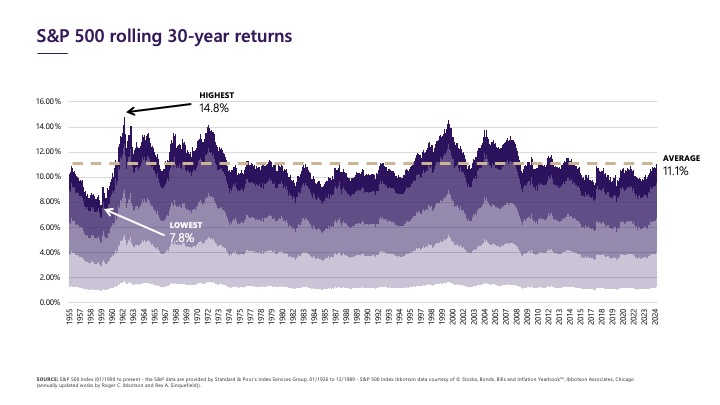
If you’re 10 plus years from retirement, you might be sitting entirely in shares, and that volatility is genuinely fine. You keep investing your income while it’s down, buying at a discount, growing your wealth over time. If you’re in or close to retirement, you’re not sitting in just the S&P 500 (hopefully). You should be invested in a genuinely diversified portfolio, which means your range of outcomes is narrower than the S&P 500’s average. See rule 4.
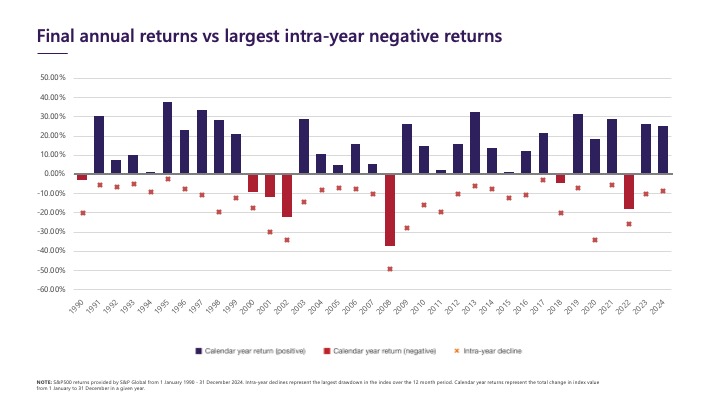
The really interesting part of this graph isn’t the year-end number; it’s what happens during the year. In 1997, the market dropped 10% and finished the year up over 30%. In 2003, it dropped around 15% and finished up around 30%. In 2009, recovering from the GFC, it was down nearly 30% during the year and finished up nearly 30%. More recently, in 2025, tariffs took the market down by around 20%, and there were real concerns about an oil crisis, too. Regardless, the outcomes have been strong over time.
There will be years where the market stays down for the full year; that’s real, and worth acknowledging. But the point stands: think long term, and don’t react to the news. It will always be there trying to scare you.
Rule 3: High fees equal underperformance
This is the one the finance industry doesn’t want you to know.
There are plenty of investment houses in New Zealand and around the world built on one pitch: give us your money, we’ll charge you a fee, and we’ll outperform the market over time. The data over the long term tells a different story.
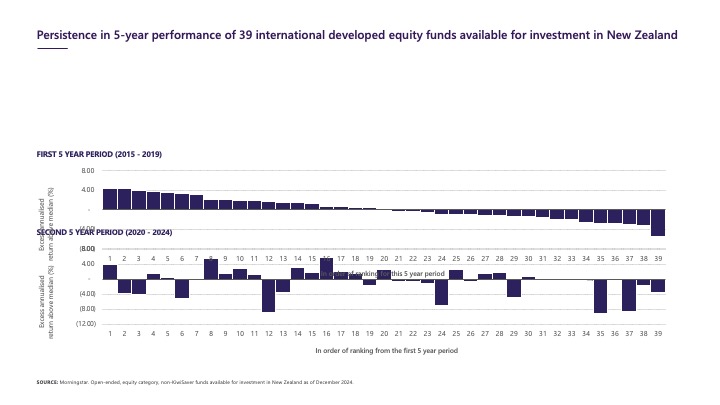
That’s not even the interesting part. The interesting part is what happens next.
Over the long term, the data points lead to a simple solution. Don’t try to outperform the market, keep your fees low, track the market, stay diversified and minimise your tax leakage. Fees get a lot of attention. Tax doesn’t get nearly enough. Even if you’re paying a low fee, if you’re leaking extra tax because of how your assets are held, the outcome is the same for you: less money in your pocket. If you’re talking to a financial adviser, the conversation should focus on low fees, genuine diversification, and tax efficiency, because that’s what the data actually support.
Rule 4: Don't just invest in the S&P 500; diversification is key
Warren Buffett, probably the greatest investor of our generation, has said that if he were starting today, he’d drip-feed into the S&P 500. He’s a lot smarter than we are. But we still come back to the data and ask what it’s actually telling us.
There are some great companies in the S&P 500. But a large chunk of that index is concentrated in around seven tech companies, trading at valuations well above what their long-term earnings would suggest. Even if you believe that can continue, it’s worth looking at what’s actually happened historically, because recency bias is a real thing.
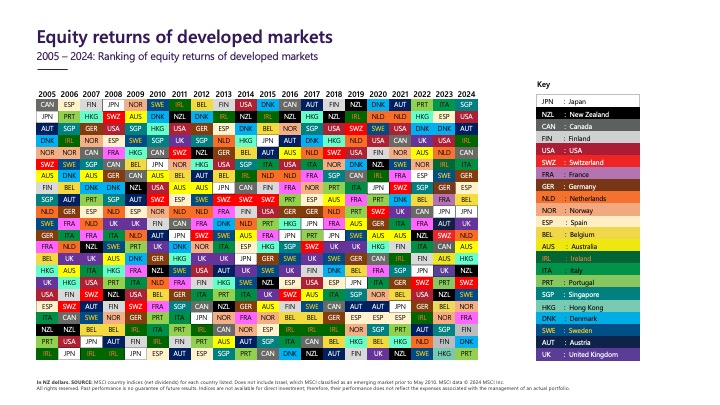
Betting your entire retirement on one country, and one that’s become increasingly divided, is a real risk. As a side note, while we’re quick to bash New Zealand, it ranked second in 2011, 2014, 2016, and 2018; first in 2019; and in the top ten in 2020. We may not be as bad as we think.
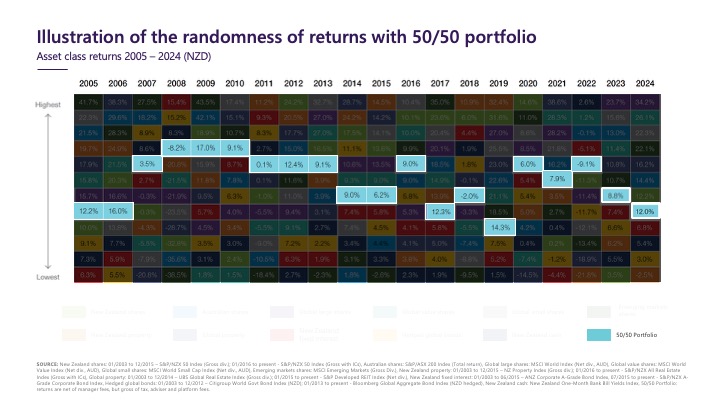
If you want a smoother ride over the long term, a diversified portfolio – roughly half shares and property, half cash and bonds- will consistently land you somewhere in the middle of the pack each year, rather than chasing whichever asset happened to win last time.
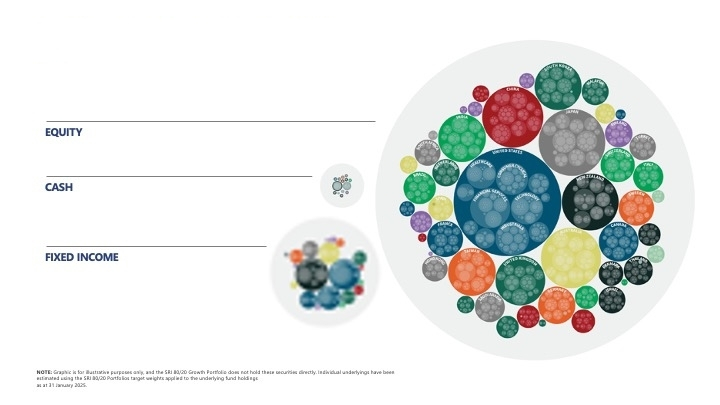
That’s how you build a retirement strategy robust enough to deal with tough times, and one that gives you that middle-of-the-pack experience over the long term instead of a bet on any single outcome.
Rule 5: Use a financial adviser, but know how they're paid
There are four ways people typically manage their retirement savings, and the way each one is paid matters more than most people realise.
DIY. The risk here is you’re ignoring everything in the four rules above, because this is likely the first time you’ve managed anyone’s retirement savings, and it happens to be your own. That tends to lead to one of three outcomes: poor decisions, real tension with your spouse given how much pressure sits on these choices, or becoming more conservative over time, which usually means you end up dying with too much money instead of getting to enjoy it.
A fund manager who also offers advice in-house.
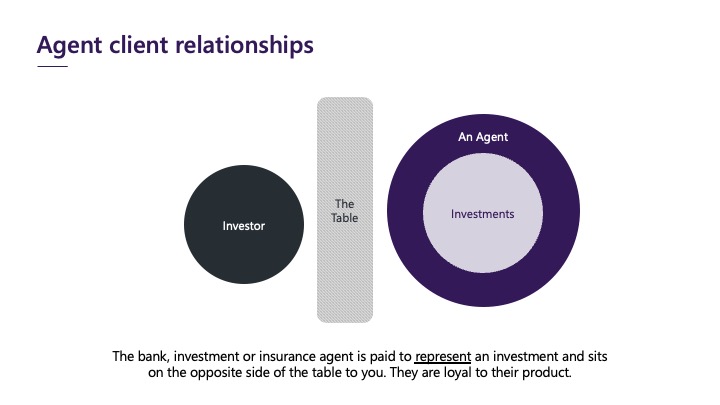
The problem here is structural. The investment solution and the adviser sit on the same side of the table, and you, the investor, sit on the other. If the fund manager pays that adviser a salary or bonus, there’s no independence. Every conflict of interest runs one direction; they’re always going to believe their own solution is the best one, and you have no real way to know if that’s true. On top of that, these are usually active fund managers, which, as we covered in Rule 3, tends to underperform over the long term.
A sharebroker.
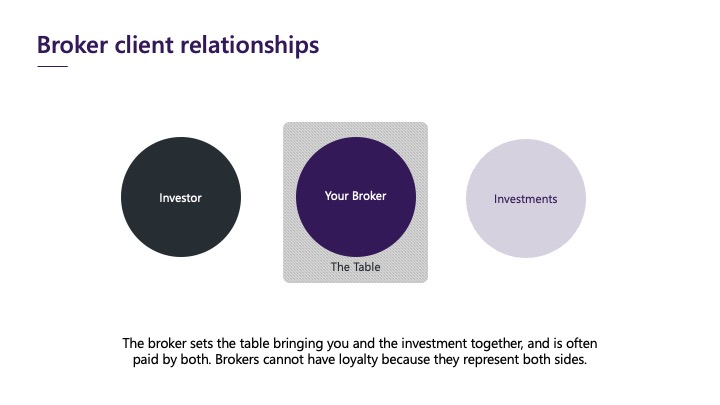
A sharebroker isn’t quite on the same side of the table as the fund manager; they essentially are the table, sitting between the investment and the investor. They do get paid by you, but a meaningful chunk of their income often comes from making trades on your portfolio. If they’re paid every time they trade, how do you know that trade is genuinely in your interest rather than theirs? The data consistently shows heavy trading activity in these portfolios. If the goal is a low-cost, diversified, tax-efficient strategy, there’s no good reason for that much activity in the first place.
An independent financial adviser.
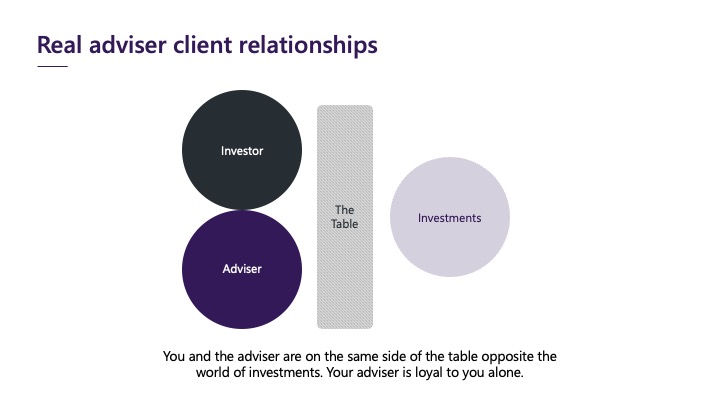
At Lighthouse, we’re proud to be independent. That means we sit on the same side of the table as you. The only way an independent adviser gets paid is by the client. No commissions, no clipping the ticket on trades, no payment from fund managers. When a recommendation gets made, the only interest being served is yours, because that’s the only way the adviser gets paid, and the only way they build a relationship that lasts.
At Lighthouse, we position ourselves not as having the fastest boat. We have a good, robust boat that will keep pace and weather stormy seas, but we don’t position ourselves as getting you to your destination faster. We are the captain of the boat. We will help you set course, adjust as we go, weather stormy seas and make sure you enjoy the journey and have peace of mind.
In summary
There are plenty more rules and opinions out there for building a strong investment strategy heading into retirement, but these five are the ones we believe matter most.
None of it means anything, though, if you don’t know what you actually want. Money is a tool to help you live the life you want, now and in the future. You can only do three things with it: spend it now, spend it later, or give it away. So before anything else, get clear on where you want to live in retirement, what your lifestyle should look like, whether you’ll help family out along the way, and the biggest question of all: whether you’re on track to run out of money or end up with far more left over than you ever needed.
After working for 20, 30, or 40 years, this is about actually enjoying the payoff – a life full of meaning and full of good memories.
If you’d like some help working through any of this, book a time with a financial adviser at Lighthouse, or use our retirement calculator as a starting point for that conversation.
Disclaimer:
The information in this article is general information only, is provided free of charge and does not constitute professional advice. We try to keep the information up to date. However, to the fullest extent permitted by law, we disclaim all warranties, express or implied, in relation to this article – including (without limitation) warranties as to accuracy, completeness and fitness for any particular purpose. Please seek independent advice before acting on any information in this article.