New Zealand has been ranked the sixth most taxed country in the world, with tax revenue accounting for 32.6% of GDP, according to figures discussed from Visual Capitalist. But is New Zealand facing a tax crisis because we're paying too much, or is our economy simply not growing fast enough?
Is New Zealand Really the Sixth Most Taxed Country in the World?
New Zealand’s position as the sixth most taxed country in the world might come as a surprise, particularly when compared with countries that have additional taxes, such as capital gains tax and inheritance tax.
According to the ranking discussed, New Zealand collects tax revenue equivalent to 32.6% of its gross domestic product (GDP), placing it ahead of countries including Australia, Canada and the United Kingdom.
However, there’s an important distinction to make.
The ranking measures tax revenue as a percentage of GDP, rather than how much an individual pays in tax.
This means New Zealand’s position reflects the relationship between the amount of tax collected and the overall size of its economy.
It’s a distinction that raises an interesting question: are New Zealanders genuinely overtaxed, or does our relatively small and slow-growing economy make our tax burden appear higher?
The answer isn’t necessarily straightforward.
New Zealand collects revenue through several different taxes, including income tax, GST, fuel taxes and rates, alongside various levies.
Yet unlike some other countries, New Zealand doesn’t have a comprehensive capital gains tax or inheritance tax.
So, despite having fewer types of taxes in certain areas, we’re still collecting a comparatively large proportion of our economy in tax revenue.
That raises questions about whether our tax system has the right balance and whether introducing additional taxes would actually improve the country’s financial position.
Is New Zealand's Tax Crisis Hurting Economic Growth?
One of the biggest concerns surrounding New Zealand’s tax crisis is whether increasing taxes could ultimately do more harm than good.
The relationship between taxation and economic growth isn’t simply a case of higher taxes generating more government revenue.
There’s a theory that tax revenue follows a bell-shaped curve.
At one end, a country collecting no taxes generates no tax revenue. As tax rates increase, government revenue generally rises.
However, beyond a certain point, higher taxes may begin to discourage the economic activity that generates that revenue in the first place.
People might become less motivated to work additional hours, start businesses or invest. Others may consider moving overseas.
Eventually, increasing tax rates could become counterproductive if the resulting reduction in economic activity outweighs the additional revenue collected.
The challenge is identifying where New Zealand sits on that curve.
With the country already collecting a significant proportion of GDP through taxation, there is an argument that introducing more taxes could place additional pressure on productivity and economic growth.
Rather than continually looking for new sources of tax revenue, perhaps the bigger opportunity lies in creating an environment where businesses can grow, people can earn more and the economy becomes more productive.
How Does New Zealand's Tax System Compare to Australia?
Australia is often the first country New Zealanders look towards when comparing wages, living costs and financial opportunities.
But when it comes to taxation, the differences are more complicated than they initially appear.
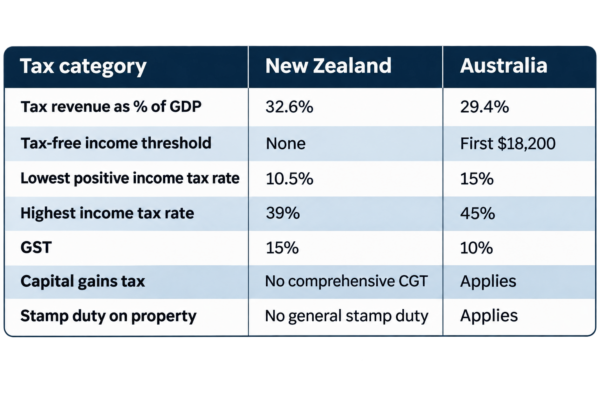
According to the figures discussed, Australia’s tax revenue accounts for 29.4% of GDP, placing it 14th in the ranking, compared with New Zealand’s 32.6% and sixth-place position.
There are also some notable differences between the two countries’ tax systems.
Are Lower-Income Earners Better Off in Australia?
One of the most significant differences is Australia’s tax-free income threshold.
In New Zealand, income tax applies from the first dollar earned, whereas Australians benefit from an initial tax-free threshold.
This can make Australia’s income tax system more favourable for lower-income earners.
However, the comparison changes as income increases.
At approximately $200,000 in annual income, the income tax burden between the two countries was described as being relatively similar.
Above that level, New Zealand can become more favourable from an income tax perspective, although the difference may be smaller than people expect.
But income tax is only part of the picture.
Australia also has a lower GST rate, exemptions on certain staple goods and employer superannuation contributions of 12% on top of salary.
These differences can have a meaningful impact on household finances, particularly when a large proportion of income is spent on everyday essentials.
It’s also worth considering that Australians generally earn higher wages, making it difficult to attribute the country’s financial appeal to tax differences alone.
Does New Zealand Have the Wrong Mix of Taxes?
Rather than focusing solely on how much tax New Zealand collects, another question is whether we’re taxing the right things.
For most salaried employees, income tax is largely unavoidable.
Every additional dollar earned is subject to the relevant income tax rates, reducing the amount available to spend, save, invest or repay debt.
One argument is that taxing employment income less heavily could encourage greater productivity.
If workers retained more of their earnings, they might have greater capacity to reduce their mortgages, build investments or spend within the economy.
An alternative approach could involve placing greater emphasis on taxing wealth creation or investment gains.
However, that introduces another set of considerations.
Different taxes influence financial decisions in different ways, and changing the balance could affect everything from property investment to business ownership.
The challenge is finding a system that generates sufficient government revenue without discouraging the economic activity needed to grow the country.
Property Taxes: New Zealand vs Australia
Property investment highlights just how differently the two countries approach taxation.
Australia has several taxes associated with property ownership and transactions that New Zealand doesn’t generally have, including stamp duty, capital gains tax and land tax in certain circumstances.
However, Australian property investors also benefit from certain deductions and concessions.
For example, Australia’s negative gearing arrangements allow investors to offset eligible property losses against other income, while New Zealand has ring-fencing rules restricting how residential rental property losses can be used.
Australia also offers certain depreciation deductions that aren’t available in the same way to New Zealand property investors.
This creates an interesting distinction.
New Zealand can offer advantages when an investment property is sold, while Australia can provide benefits during the period an investor owns the asset.
Could a Capital Gains Tax Change Property Investment?
The possibility of introducing a capital gains tax in New Zealand raises further questions about how other property tax rules might need to change.
If investors were required to pay tax on capital gains when selling an asset, there could be an argument for allowing greater deductions against the costs of holding that investment.
For example, restrictions on offsetting rental losses might warrant reconsideration if gains were also being taxed.
Otherwise, investors could find themselves unable to offset losses incurred while holding an asset, only to face tax on the eventual gain.
The broader point is that tax policies shouldn’t necessarily be considered in isolation.
Changes to one part of the system can have implications for other areas, particularly when it comes to investment decisions and the incentives created by different tax treatments.
Is New Zealand's Real Problem Tax or Productivity?
While New Zealand’s tax ranking has attracted attention, the way it’s calculated raises another important issue.
If tax revenue is measured as a percentage of GDP, then the size of the economy plays a significant role in determining where a country ranks.
For example, if New Zealand’s GDP increased while tax revenue remained unchanged, the percentage of GDP represented by tax would fall.
That means improving economic productivity could potentially change New Zealand’s position in the ranking without reducing tax rates.
So perhaps the question isn’t simply whether we’re paying too much tax.
It’s whether New Zealand is generating enough economic activity to support the level of taxation we’re collecting.
One argument is that reducing taxes could help stimulate growth by leaving more money in the hands of workers and businesses.
This could encourage spending, investment and greater economic activity, although there are also potential inflationary consequences to consider.
Another approach is to focus on the broader factors limiting productivity, including infrastructure, investment and international trade.
Ultimately, the country’s tax burden and economic performance are closely connected.
Could Immigration Help Grow New Zealand's Economy?
Immigration is another factor worth considering when discussing New Zealand’s economic growth.
Bringing skilled workers and business owners into the country can increase economic activity, particularly when migrants fill important gaps in the workforce or establish new businesses.
More people working, earning and contributing to the economy can help increase GDP.
However, immigration also creates additional demand for housing, transport and public infrastructure.
For example, bringing more doctors into the country may help address workforce shortages, but those workers and their families still need somewhere to live, roads to travel on and infrastructure to support their communities.
If population growth outpaces infrastructure development, the resulting pressure can create additional economic challenges.
Auckland was highlighted as an example of how periods of significant population growth can leave infrastructure struggling to keep up.
Turning Infrastructure Demand Into Economic Opportunity
Rather than viewing infrastructure demand solely as a cost, there’s also an argument that it represents an opportunity for New Zealand.
Building the infrastructure needed to support a growing population creates opportunities for investment and economic development.
This raises questions about how New Zealand could better utilise available capital, including KiwiSaver funds, private investment and overseas investment.
With a significant proportion of KiwiSaver investment currently directed offshore, there may be opportunities to encourage more domestic investment into projects that support New Zealand’s long-term growth.
However, achieving that would require addressing the barriers that can slow infrastructure development, including regulation, investment settings and decision-making.
The challenge is finding ways to turn demand for infrastructure into productive economic activity rather than allowing it to become a constraint on growth.
Why International Trade Matters for New Zealand's Future
For a relatively small country located a considerable distance from major international markets, trade plays an important role in New Zealand’s economic prospects.
Growing the economy isn’t simply about increasing spending or moving money between businesses and households domestically.
It’s also about creating opportunities to generate additional economic value through international relationships and trade.
This raises questions about the role government should play in promoting New Zealand overseas.
While reducing regulation and allowing businesses to operate efficiently are important considerations, there is also an argument that government has a responsibility to actively support international trade opportunities.
That includes building relationships with other countries, negotiating trade agreements and ensuring New Zealand is represented effectively on the international stage.
For a country looking to improve productivity and expand its economy, developing stronger international commercial relationships could be an important part of the solution.
The broader challenge is ensuring that New Zealand has the leadership, infrastructure and economic environment needed to compete internationally.
Key Takeaways
- New Zealand ranks sixth for tax revenue as a percentage of GDP: The 32.6% figure reflects the proportion of economic output collected in tax, rather than an individual’s tax rate.
- Australia collects a smaller share of GDP in tax: Australia’s figure of 29.4% places it 14th in the ranking discussed, despite having additional taxes in areas such as capital gains and property transactions.
- The mix of taxes matters: Income tax, GST, property taxes and investment-related taxes all influence financial decisions and economic behaviour differently.
- Higher taxes don’t automatically mean better outcomes: There is a point at which additional taxation could discourage investment, business activity and productivity.
- New Zealand and Australia offer different advantages: Australia can be more favourable for lower-income earners, while New Zealand may offer advantages for certain higher-income earners and investors.
- Property tax reform has wider implications: Introducing a capital gains tax could raise questions about existing deductions, negative gearing and ring-fencing rules.
- Economic growth is central to the debate: Increasing GDP could reduce tax revenue as a percentage of the economy, even without changing the amount of tax collected.
- Infrastructure and trade are important growth opportunities: Better investment, infrastructure development and international commercial relationships could help support New Zealand’s productivity.
Next Steps
If you’re looking to better understand how New Zealand’s tax rules affect your business, investments or wider financial position, get in touch with Lighthouse Financial’s accounting team to explore your options.
If you’d like to watch more, check out this episode below.
For a no obligation discussion to see how we can help you on the path to wealth, please
contact us.
Disclaimer:
The information in this article is general information only, is provided free of charge and does not constitute professional advice. We try to keep the information up to date. However, to the fullest extent permitted by law, we disclaim all warranties, express or implied, in relation to this article – including (without limitation) warranties as to accuracy, completeness and fitness for any particular purpose. Please seek independent advice before acting on any information in this article.


